|
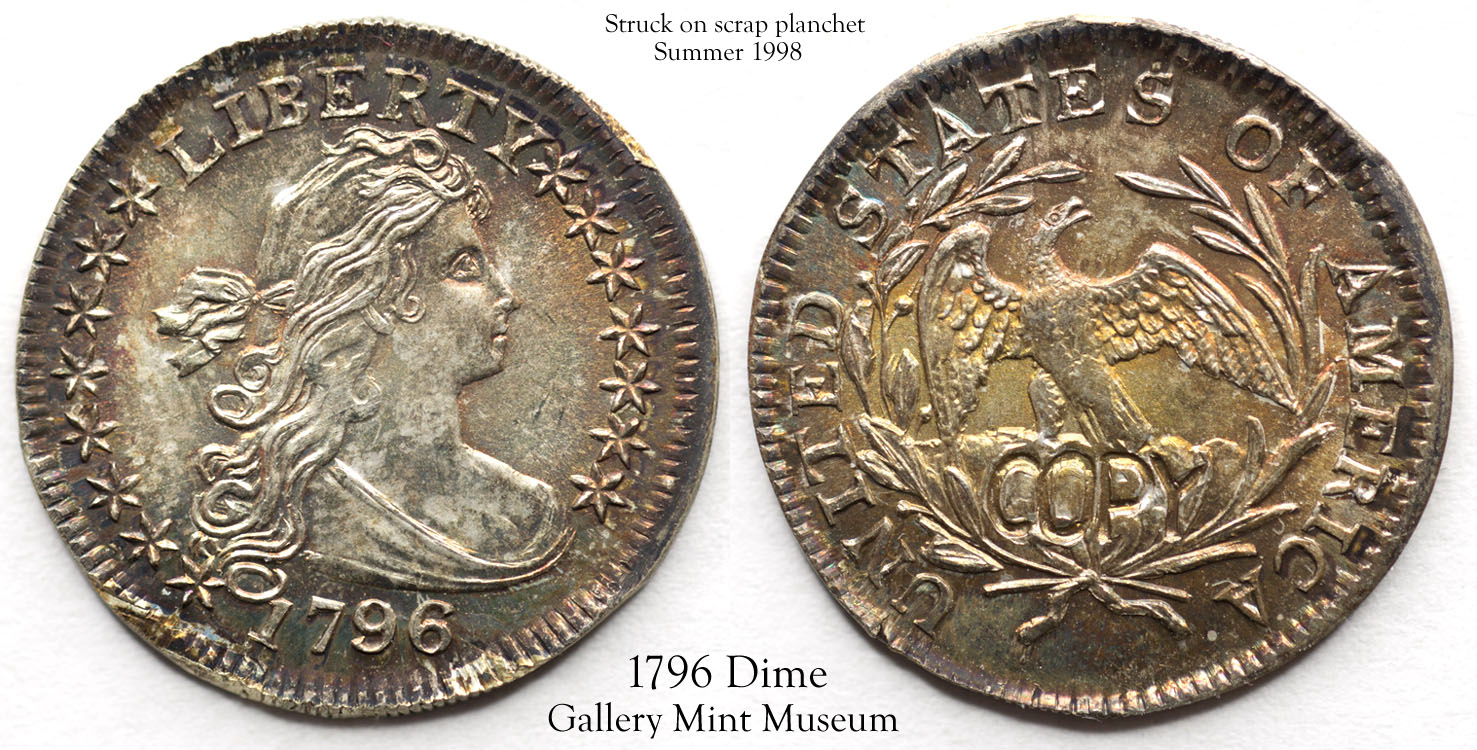
1796 Dime (Gallery Mint Museum) - struck by me
Back in the summer of 1998, we took a family vacation to Branson, MO in my
mother-in-law's camper. This was back when the Gallery Mint was still in operation
in Eureka Springs, AK. On the way back I was able to get on contact with Ron Landis,
who invited us to visit their facility. This place was definitely off the grid, and
we almost didn't find it (no GPS back in those days). It was quite the experience,
seeing Ron's dies he used to strike coins, and the old screw presses, maintained by
Joe Rust. I purchased a few GMM pieces that day, including the 2000 fantasy dollar
featuring Miss Liberty (which would have made a spectacular Federal Issue, had this
idea come to fruition). However, in the process of leaving, I had asked Ron if I could
strike a coin myself. After finding a scrap silver planchet that was about dime-sized,
he allowed me to strike this 1796 dime, which is featured here. It has sat in a metal
box until this day (I'm writing this in 2022), in which it has developed some rather
attractive toning.
|

|
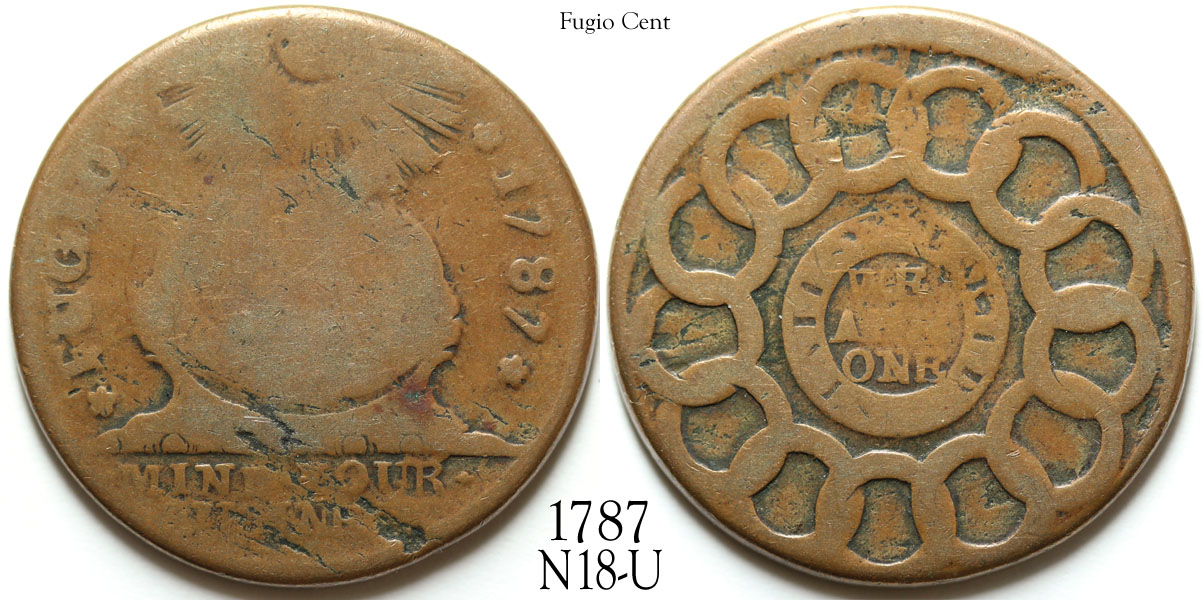
1787 Fugio Cent Newman 18-U
A coin designed by Benjamin Franklin! I purchased this from a fellow EACer -
just a nice, smooth good, with planchet striations on the obverse, which is typical.
Colonials are not my area of expertise, but I had
always wanted a Fugio, and this was a nice one I couldn't pass up. Normally
I attribute all of my coins, but I needed help with this one.
|
|
|
1787 New Jersey Colonial Copper Maris 6-D
My second New Jersey copper, and maybe just a TAD nicer than the other one, the 48-G.
I purchased this from the man who literally wrote the book on these, Michael Demling,
at the FUN show in January 2015. I also bought his book to go along with the coin.
There's something charming about the crudeness
of these - the horse's ears look like an "M". I'm not currently forming a collection
of New Jerseys (I'm writing this as of 4/2016,) but of course that's subject to change.
(If you like New Jersey coppers and don't have Mike's book, it's a must-have!)
|
|
|
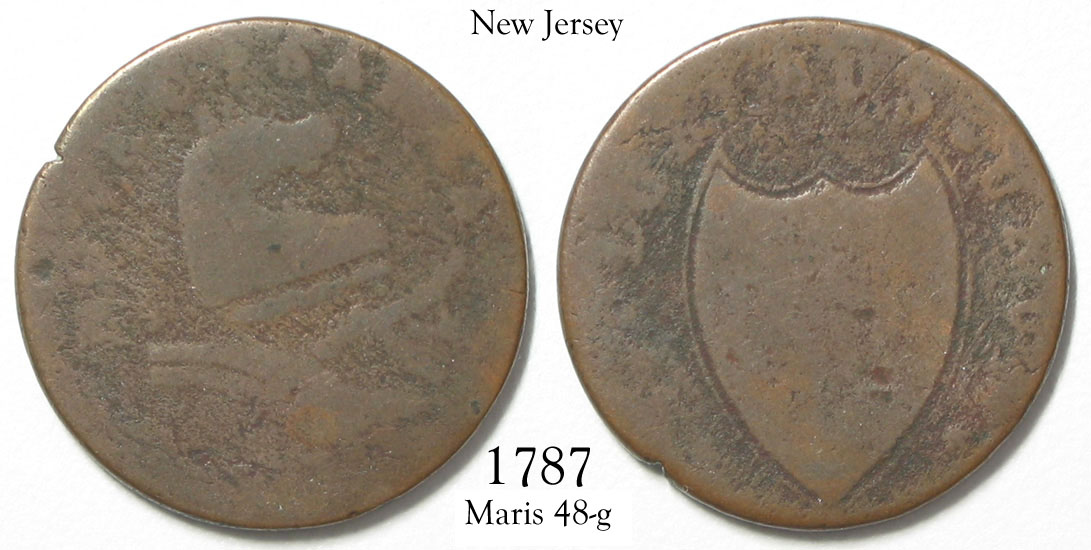
1787 New Jersey Colonial Copper Maris 48-G
My first colonial coin! I traded a MS64 Franklin Half Dollar for it in
January 1998. Not the prettiest coin around. It has a horse's head and
plow on the obverse (and a partial date, if you use your imagination) and
a shield on the reverse. The motto NOVA CAESAREA (New Jersey) appears on
the obverse and E PLURIBUS UNUM is on the reverse. At least a partial motto
appears on both sides of this coin. According to Breen's Encyclopedia, this
particular coin was struck by Matthias Ogden in early 1788, but was backdated
1787. It's a common variety.
|
|
|
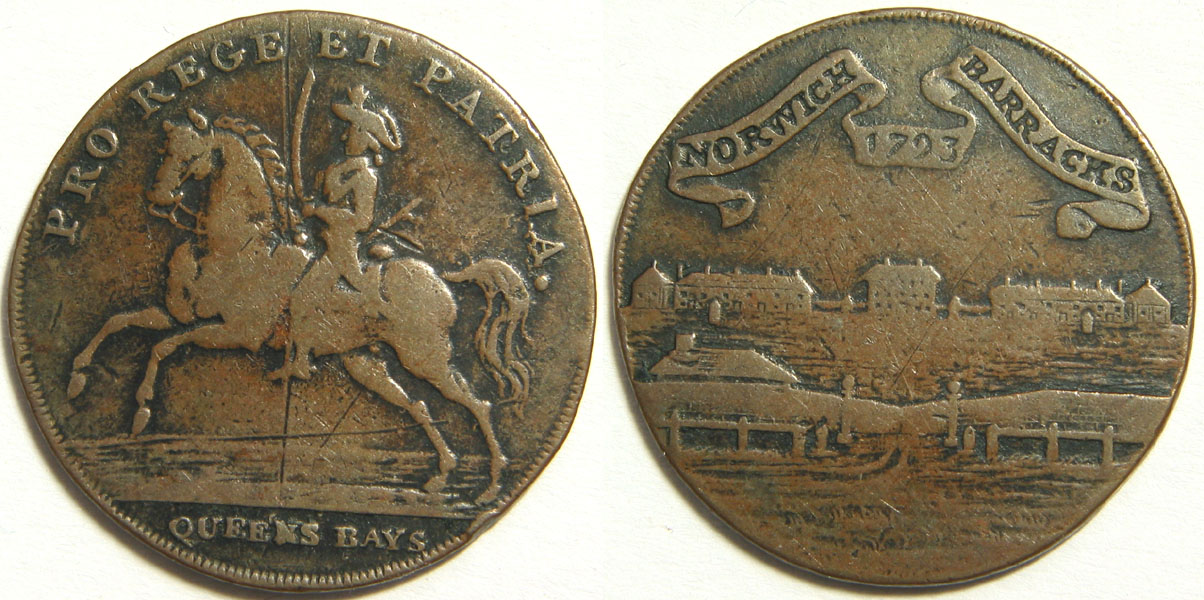
1793 Norfolk Conder Token
I received this as part of a large cent purchase I made a long time ago.
A local Conder expert was able to attribute it for me as a Norfolk 47a,
plain edge variety.
|
|
|
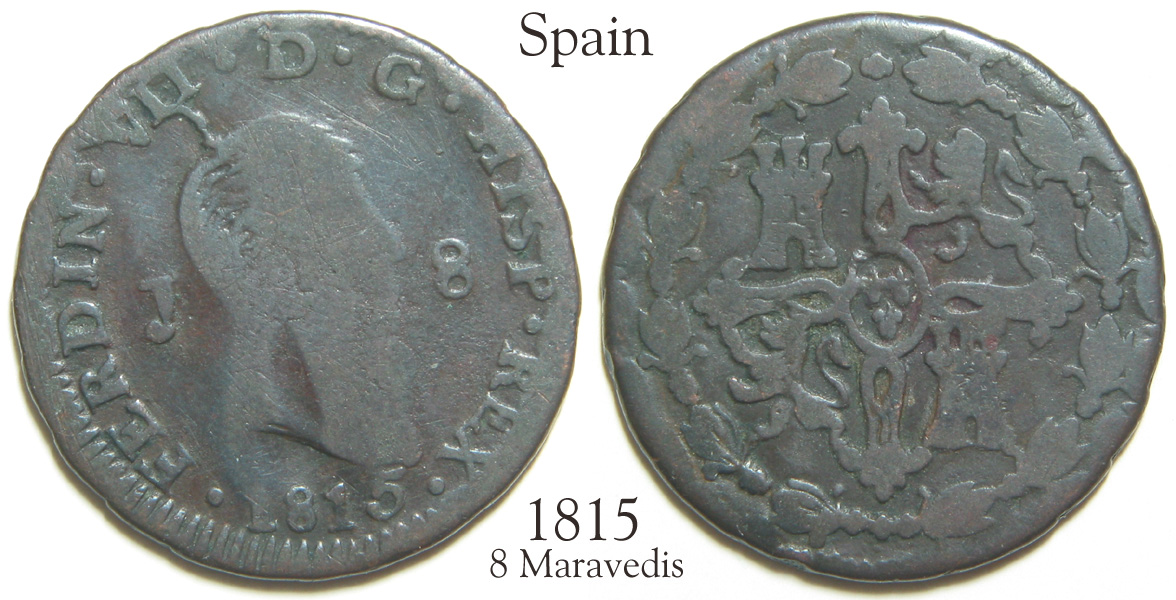
1815 Spanish 8 Maravedis
What's this doing here, you might ask? It's basically a large cent sized coin, dated
1815. Since no large cents were dated 1815, this is my "hole filler" for the date.
Neat coin, with a large die crack in the upper obverse.
|

|
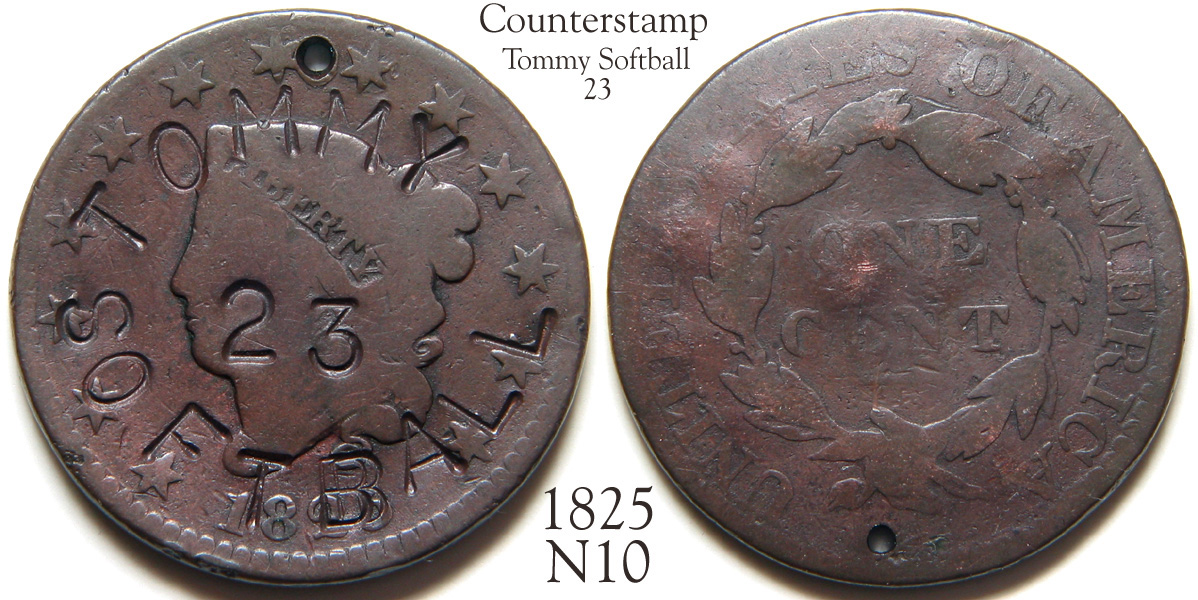
1825 N10 "Tommy Softball 23" Counterstamp
An incredibly rare and historic counterstamp. This counterstamp commemorated and honored
Tommy "Crazy Shoes" Deconstanzo, the little-known inventor of softball, probably
in the mid-1850's when Tommy invented the game. Tommy is also credited with the invention
of the balk, and he was known to be strictly opposed to the DH rule.
Only about half a dozen examples of the counterstamp are known to exist today.
All are counterpunched over an 1825 large cent, the year of Tommy's birth. Furthermore,
all known examples feature a small hole at K12, as these were purportedly worn around the
necks of the players of the fledgling sport as a symbol of good luck.
This particular "Tommy Softball 23" counterstamp is struck over an 1825 N-10, which
is an R3+ variety. The coin boldly displays Tommy's uniform number, 23, in the center
of the bust, which is a unique placement of the numeral; all other known examples
have "23" stamped to the left side. The "B" in "SOFTBALL" is also boldly double-punched,
adding to the mystique of this legendary coin.
|
|
|
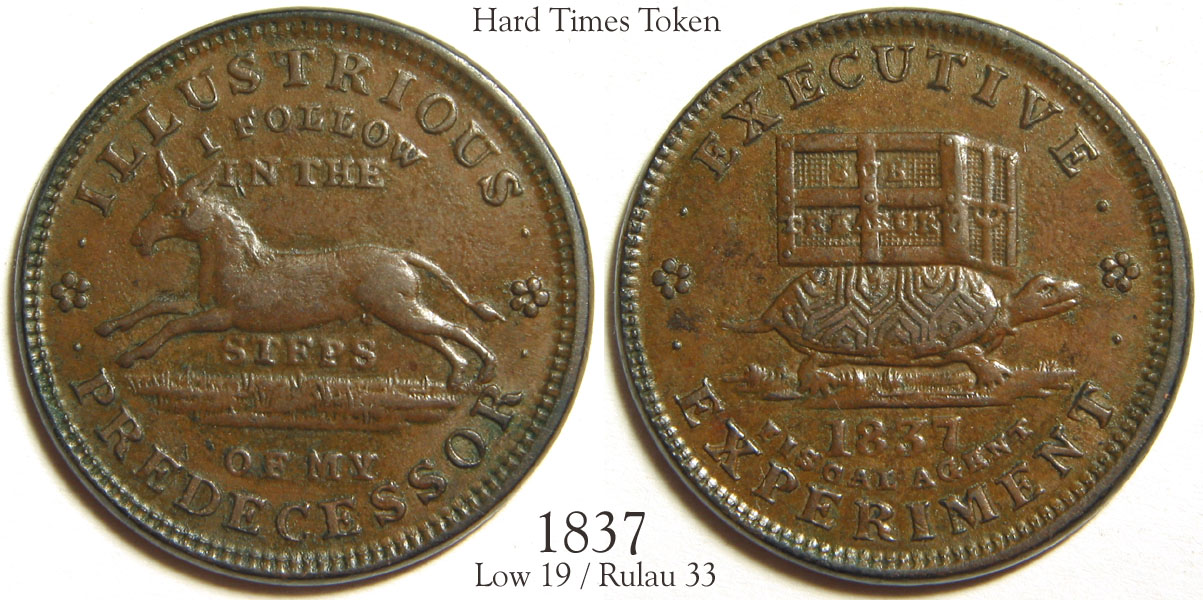
1837 Hard Times Token Low 19/Rulau 33 "Executive Experiment"
A neat piece I purchased on eBay. I figure every early copper collector should have
at least one hard times token.
|
|
|
1837 Feuchtwanger Cent Low 120/Rulau 268
An interesting private issue made of german silver, produced and circulated by
Lewis Feuchtwanger, a Bavarian, during the late 1830's/early 1840's. A nice
uncirculated specimen. Die pairing 6-I, which is common.
|

|
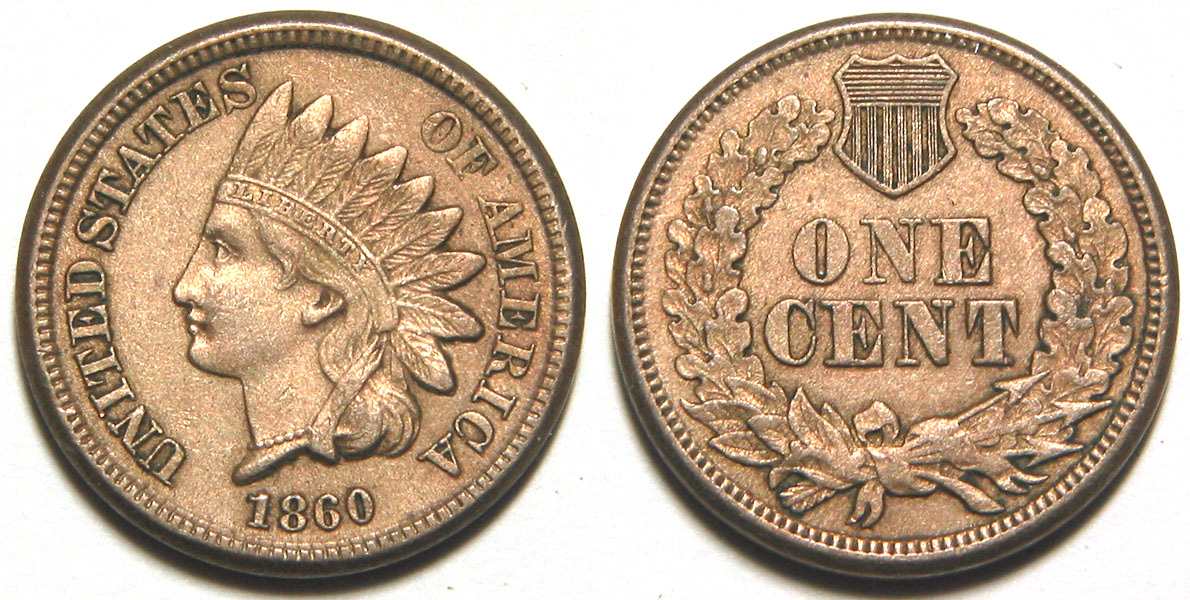
1860 Indian Cent
A high grade pleasing example.
|
|
|
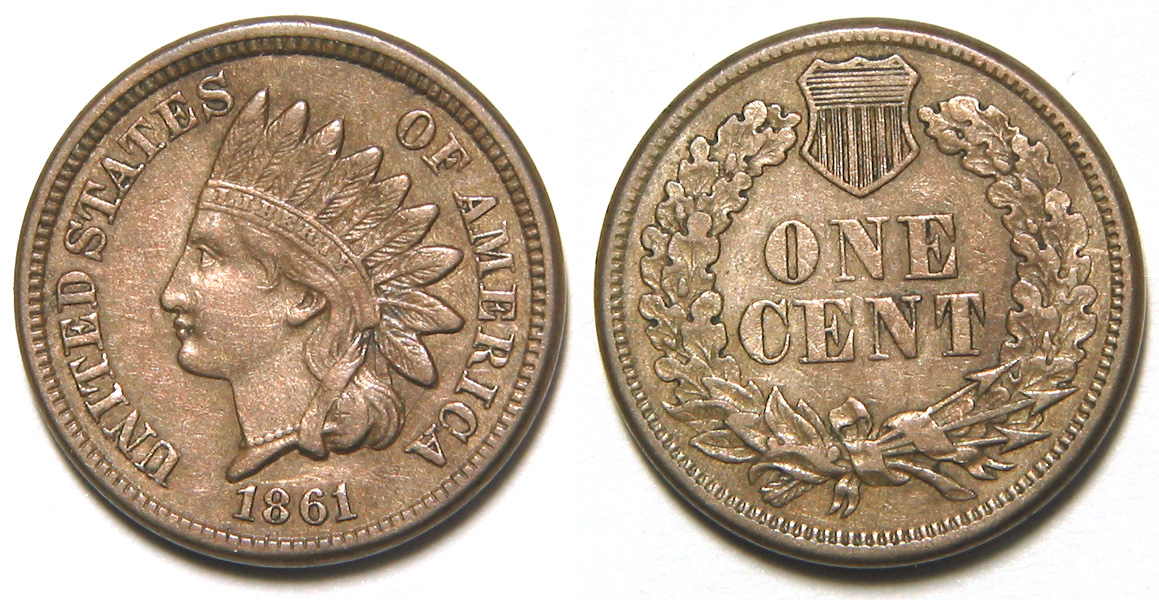
1861 Indian Cent
A nice example of the toughest date in the short Copper Nickel series.
|
|
|
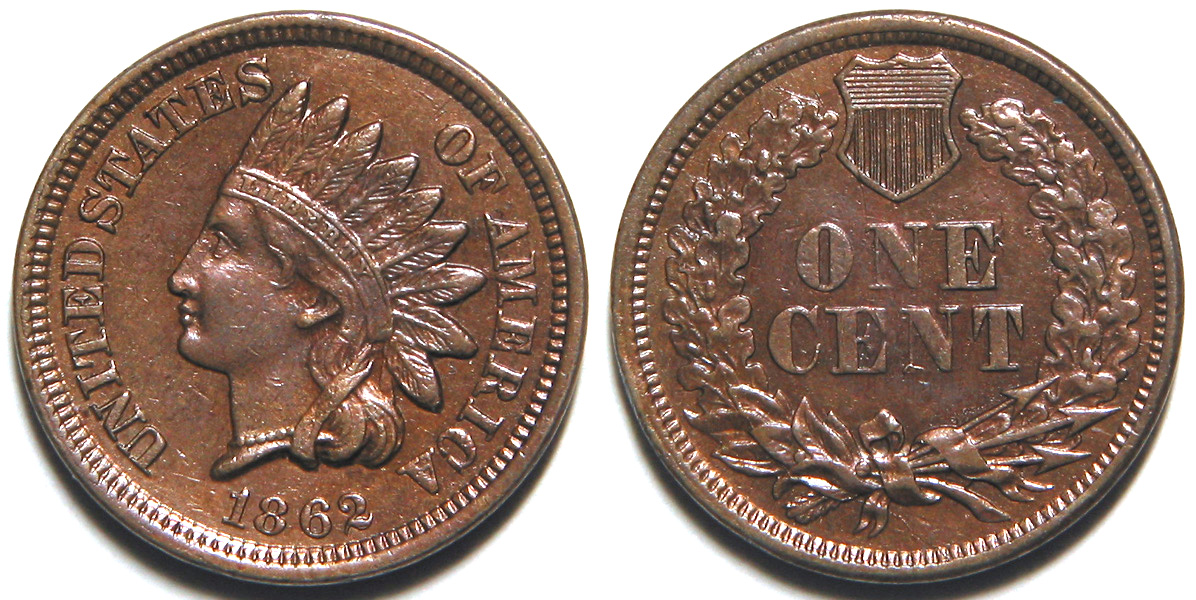
1862 Indian Cent
A choice XF+ example. Bought from Rick Snow, the leading expert in Indian cents.
|
|
|
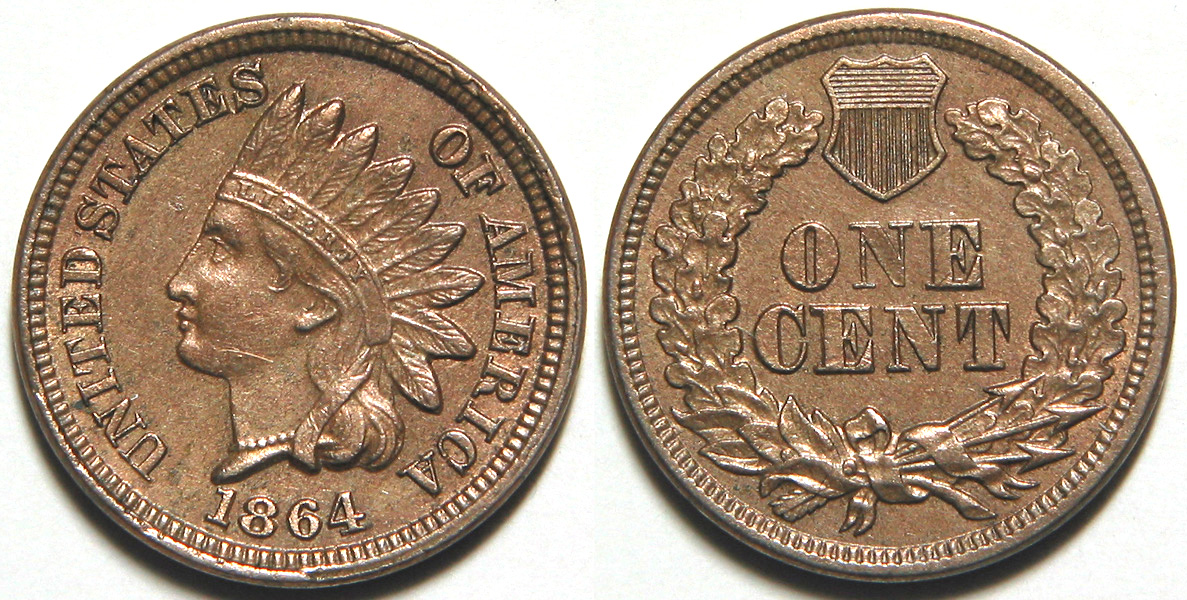
1864 Indian Cent (Copper Nickel)
A nice XF+ example. Not easy to find decent 1864 copper nickel cents.
Purchased from Rick Snow.
|
|
|
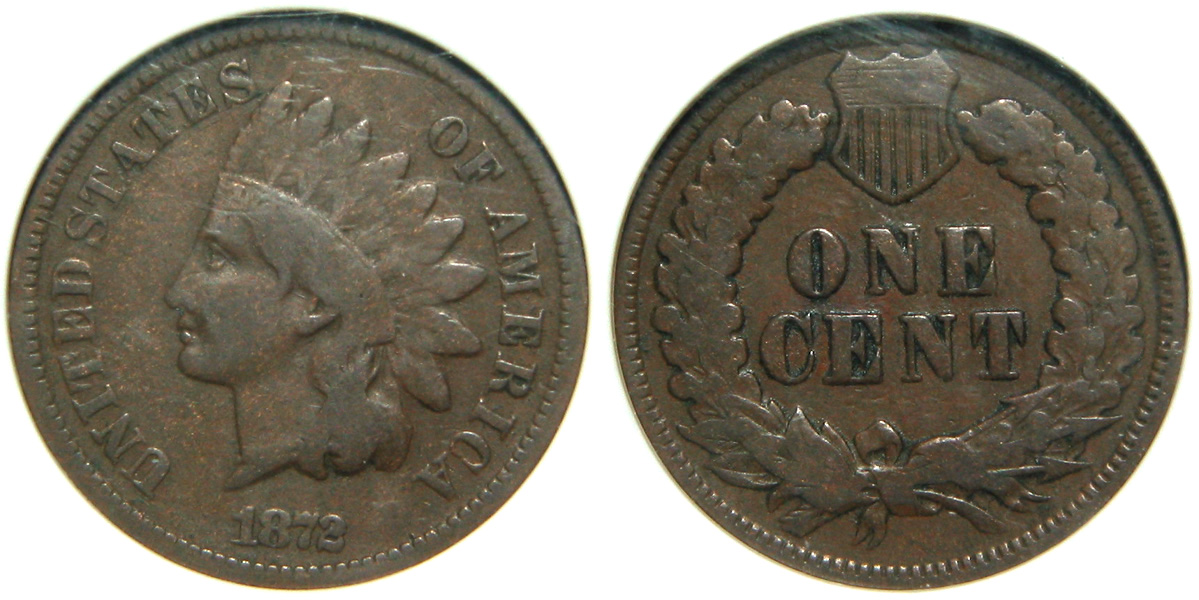
1872 Indian Cent
I got this off eBay. Tough to find as a date, and especially in VG for some
reason. Housed in an ANACS slab.
|
|
|
1909-S Indian Cent
A nice, low-grade no problem coin! I got this as part of my commission for
selling coins on eBay. Yes, I will work for one cent (if it's the RIGHT cent.)
|

|
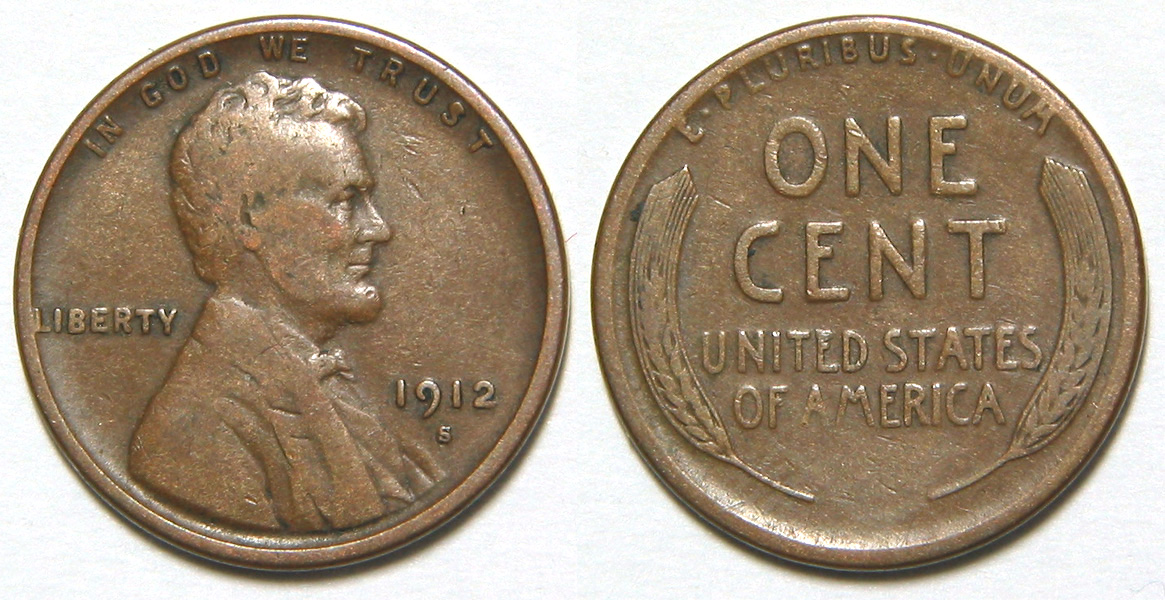
1912-S Lincoln Cent
A nice example of this semi-key date.
|
|
|
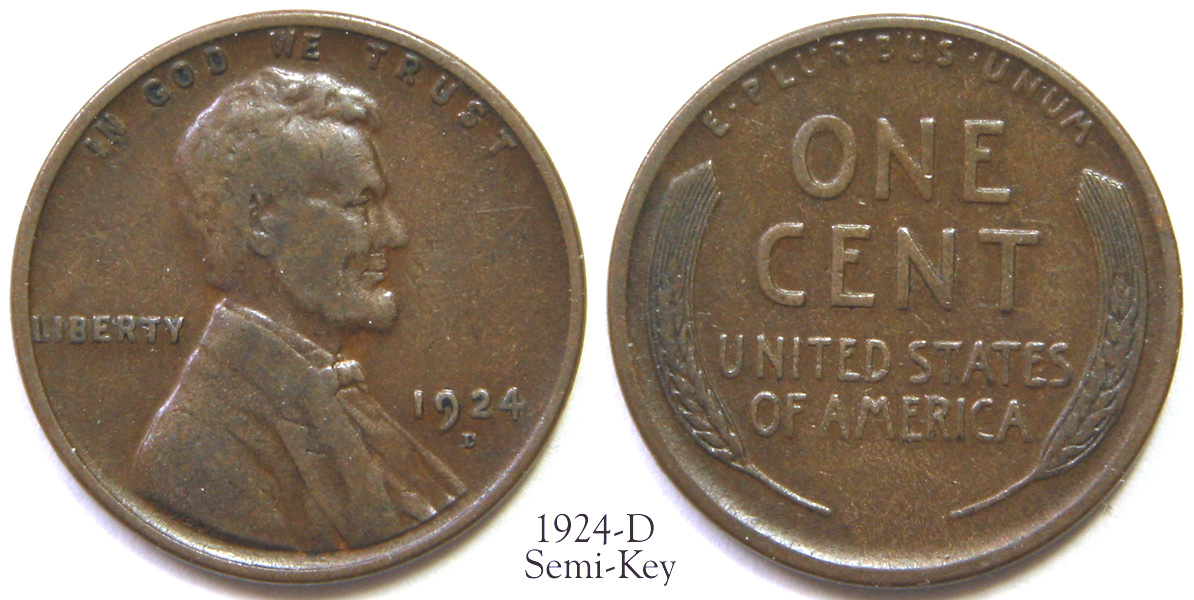
1924-D Lincoln Cent
A nice example of this semi-key date.
|

|
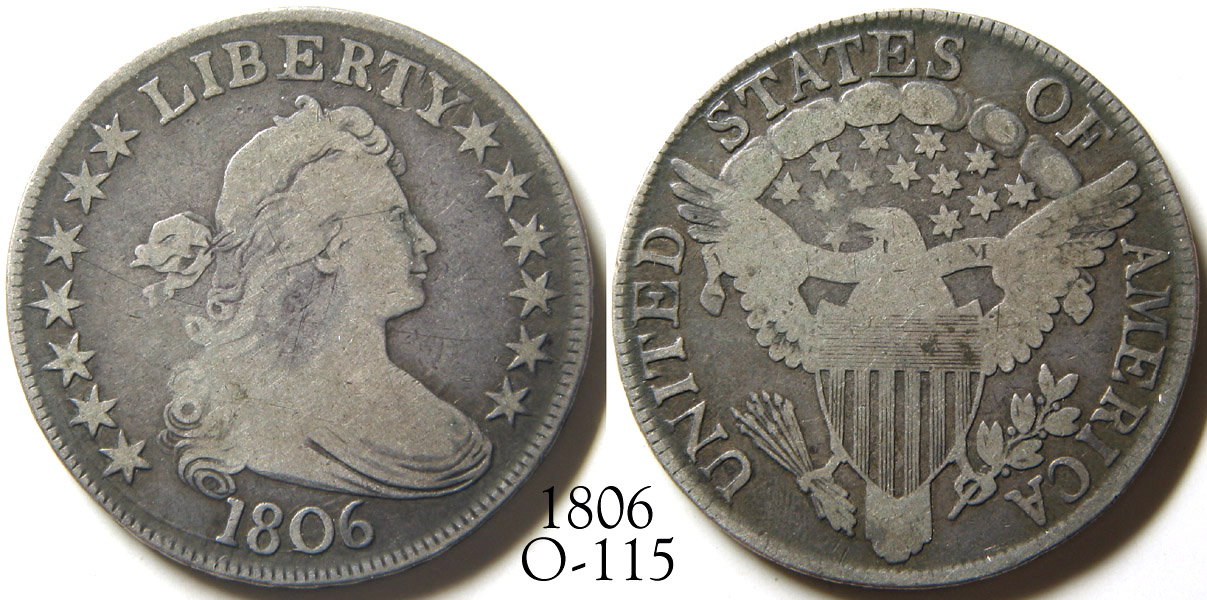
1806 O-115 Draped Bust Half Dollar
Part of a large type collection that was purchased locally. I don't really
collect these, but if I ever do this is a good place to start. TY of LIBERTY
are repunched, and there's a die crack below the date and over STAT.
Not a rare variety but a neat one.
|